


Recognizing the Warning Signs That a Bipolar Crisis Is Approaching
When you live with bipolar disorder, or love someone who does, you learn one hard truth fast. A crisis rarely comes out of nowhere.
Your mind usually sends signals first. Small shifts. Strange changes. A little less sleep, a little more dread, a little more speed in your thoughts, and then the ground starts to tilt.
That matters because early recognition gives you time. Time to slow things down, call your prescriber, protect sleep, bring in support, and avoid choices you can’t easily undo.
Research backs this up. A 2021 study using real-time symptom tracking found that mood episode shifts in bipolar disorder were preceded by at least one early warning signal, and a 2024 review found that mood swings, depression, and anxiety, especially panic, were among the most reliable signs before an episode.
The window can open weeks before a full crash or surge. The early prodrome, which is the phase before a full episode, can begin up to four weeks ahead, while the late prodrome can show up days or even hours before things get dangerous.
If you can spot bipolar disorder warning signs before a crisis takes hold, you have more options. That is the whole point of this post.
Why Warning Signs Matter More Than Symptom Lists
A warning sign is not just any bipolar symptom. It is a change from your usual baseline that tends to show up before your episodes.
That is why generic lists only help so much. Plenty of people know mania can involve less sleep or that depression can involve low energy, but what helps in real life is knowing which shift tends to come first for you.
Maybe your first sign of mania is not euphoria. Maybe it is staying up late organizing closets, sending long texts, and feeling oddly certain that everybody else is moving too slowly.
Maybe your first sign of depression is not crying. Maybe it is leaving messages unanswered, rereading the same paragraph six times, and feeling your body turn heavy before your mood fully drops.
That personal pattern is gold. It is more useful than memorizing textbook symptoms because it gives you something you can actually act on.
What Warning Signs Actually Are, And Why Yours Are Personal
Your brain has mood circuits that regulate energy, sleep, reward, attention, and threat detection. When those circuits start drifting out of balance, your behavior usually changes before a full manic, hypomanic, mixed, or depressive episode becomes obvious.
That early drift is what you are trying to catch. Not the fire, but the smell of smoke.
The most useful warning signs are the ones that repeat across your own episode history. If a sign shows up before most of your episodes, it deserves a place on your personal list.
This is why self-knowledge comes first. Before treatment changes, before crisis planning, before debates about diagnoses, you need a map of how your system starts to slide.
How to Identify Your Personal Warning Signs
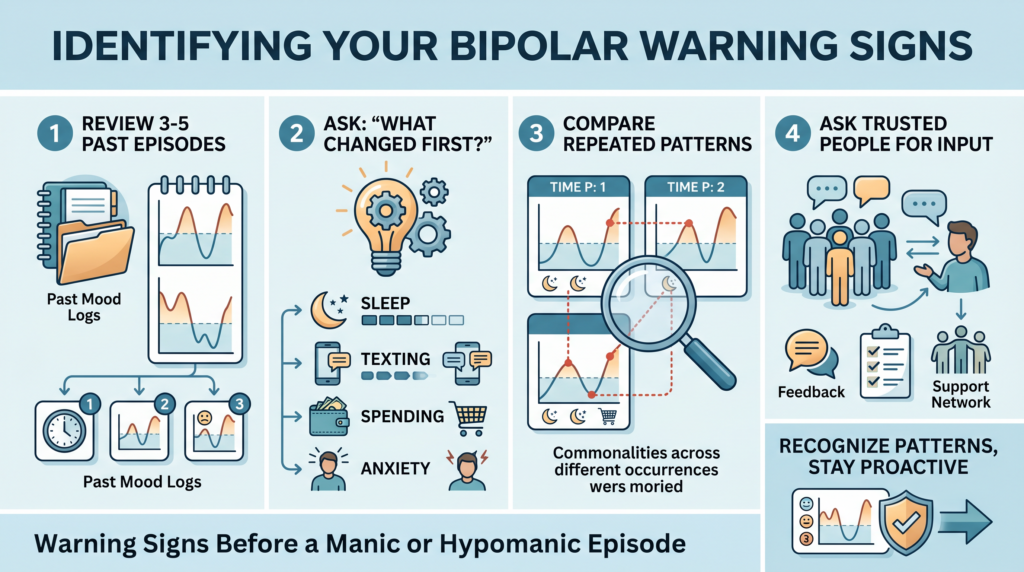
Start by looking back at three to five past episodes if you can. Focus on the days or weeks before the episode became obvious, not the peak when everything was already on fire.
Ask yourself what changed first. Sleep, spending, appetite, energy, irritability, texting habits, sex drive, talking speed, panic, hopelessness, restlessness, missed work, skipped showers, grand plans, or a weird sense that your brain was no longer moving at normal speed.
Then ask someone close to you. Partners, family members, and close friends often notice shifts before you do, especially if insight gets blurry during mood elevation.
You can also use mood tracking data, journaling, or a relapse prevention worksheet to spot patterns. If you use a tool like Therapist Aid or a mood app, it can help turn blurry memories into a clearer sequence.
Write down what you find. Keep it simple and concrete.
“I stop replying to texts” is better than “I withdraw socially.” “I sleep five hours and feel totally fine” is better than “sleep changes.”
Warning Signs Before a Manic or Hypomanic Episode
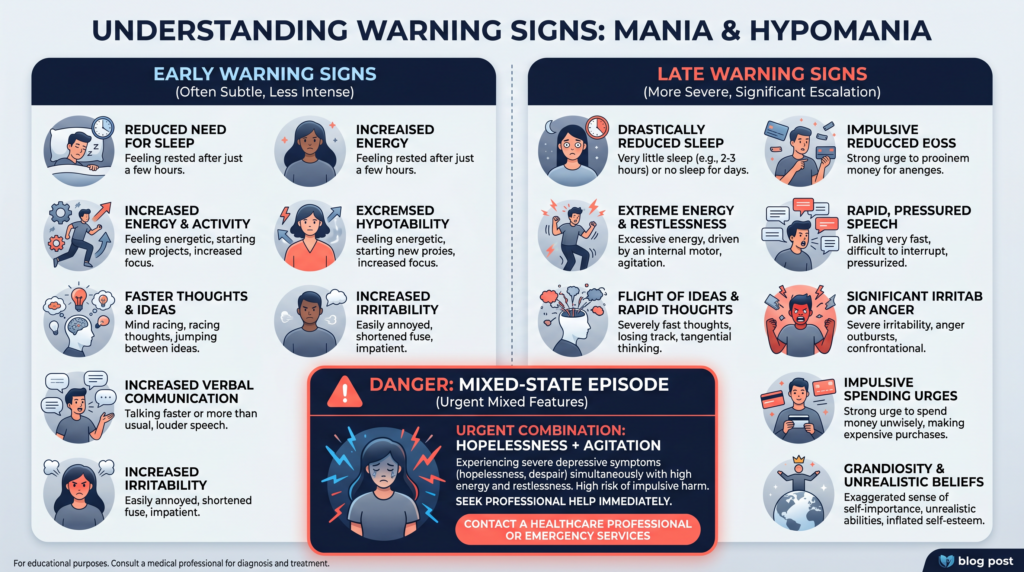
When a manic or hypomanic episode is building, your brain’s reward and activation systems start pressing the gas pedal too hard. That can raise energy, lower the felt need for sleep, speed up thinking, and make new ideas feel unusually urgent and important.
The earliest signs often show up days to weeks before a full episode. Sleep is often the first one.
You may start needing fewer hours and feel fine about it. Not tired, not dragging, just weirdly energized on less sleep than usual.
Your energy may rise next. You feel more driven, more productive, more alive, maybe even more creative, but there is often a subtle edge to it, like your system is humming too loudly.
Mood may brighten in a way that feels bigger than the moment calls for. You may feel unusually optimistic, unusually capable, or unusually convinced that this time all your plans will finally click into place.
Ideas may start coming faster. More projects, more connections, more urgency, more tabs open in your head.
You may also get more social. More calls, more messages, more posting, more reaching out, more hunger for interaction.
The Late Prodrome Before Mania or Hypomania
As a manic or hypomanic episode gets closer, the signs usually get louder. This late prodrome can unfold over days or even hours.
Sleep often drops further. You may sleep four or five hours and still feel fully rested, or you may have trouble settling down because your brain feels too switched on.
Thoughts can start racing. Not just “busy,” but leaping, stacking, colliding, and outrunning your ability to sort them.
Speech may speed up too. You may talk faster, louder, or longer than usual, and other people may struggle to keep up.
Irritability can rise along with energy. This part gets missed because people expect mania to look cheerful, but for many of us it can look sharp, impatient, agitated, and easily provoked.
Spending urges may show up. So can sudden business ideas, risky plans, impulsive travel thoughts, or a powerful desire to make major life decisions right now.
Grandiosity can creep in quietly. You may start feeling unusually certain that other people are too cautious, too slow, too limited, or simply wrong.
The Mixed-State Warning You Should Take Seriously
Sometimes the brain does something especially cruel. It combines the speed and activation of mania with the pain and despair of depression.
That is a mixed state, and it carries the highest suicide risk. You may feel agitated, hopeless, impulsive, trapped, and unable to rest inside your own skin.
The warning signs often look like high energy plus dark thinking. You may feel driven but miserable, wired but hopeless, restless but convinced nothing will ever improve.
If you notice that combination, contact your prescriber the same day. Treat it as urgent.
Warning Signs Before a Depressive Episode
Before a depressive episode, the systems in the brain that support motivation, focus, reward, and movement begin to slow down or lose traction. The world can start feeling dimmer before you fully realize your mood has dropped.
The earliest signs often appear days to weeks before a deeper depression. Sleep may change first.
You may start sleeping more, needing naps, or waking up feeling unrefreshed. For some people, sleep gets fragmented instead, with more waking in the night and less real rest.
Energy often starts to fall in a quiet way. Tasks feel heavier, mornings get harder, and ordinary things begin to take more effort.
Interest can soften. Activities you usually enjoy may not call to you the same way.
Social withdrawal may begin early too. You may delay replying, cancel plans, or feel less able to tolerate conversation.
Mild anxiety can also rise before depression deepens. Sometimes the first clue is not sadness at all, but a low steady worry that seems to come from nowhere.
The Late Prodrome Before Depression
As the episode gets closer, the signs often become harder to ignore. Getting out of bed can start to feel like lifting your whole life with your arms.
Appetite may change. Some people lose it, while others start comfort-eating more.
Concentration usually gets worse. Reading, following a conversation, making basic choices, or finishing routine tasks may suddenly feel far harder than they should.
Negative self-talk often gets louder. You may notice more shame, more self-blame, more certainty that you are failing at things you were handling just fine not long ago.
Your body may feel physically heavy or slowed down. Even walking across a room can feel like too much.
Hopelessness is one of the most serious late signs. When your thoughts start bending toward “what’s the point,” your brain is not giving you neutral information, it is signaling risk.
The Suicidal Risk Signal
Any thought about death, dying, disappearing, or not wanting to exist counts. Even vague or passive thoughts matter.
Do not wait to see if it passes on its own. Contact your prescriber the same day, and if you are in immediate distress or danger, call or text 988 in the U.S. right away, or go to the nearest emergency room.
If you are outside the U.S., contact your local emergency number or crisis service now. If you might act on the thought, seek immediate in-person help.
Sleep Disruption Is the Warning Sign That Shows Up Everywhere
If there is one signal that cuts across almost every kind of bipolar crisis, it is sleep. Sleep is not just a side symptom, it is one of the main gears that helps regulate mood timing, stress response, and energy.
When sleep shifts, mood often follows. Reduced sleep without feeling tired can point toward mania or hypomania, while increased sleep or broken sleep can point toward depression.
That is why sleep works so well as a leading indicator. If your sleep pattern changes clearly for two or more nights, pay attention.
Not every rough night means an episode is coming. But in bipolar disorder, sleep changes deserve respect because they often show up early and often.
Common Triggers That Often Show Up Beside Warning Signs
Triggers do not cause every episode by themselves, but they can shove an already sensitive system closer to the edge. What matters is noticing when a trigger and a warning sign show up together.
Life transitions are a big one. Starting a new job, moving, ending a relationship, falling in love, going back to school, or becoming a parent can all disrupt routines and sleep.
Season changes matter for many people too. Spring and summer often raise the risk for mania, while fall and winter can lean more depressive.
Medication changes or missed doses can also destabilize mood. So can alcohol, cannabis, stimulants, and other substances that push on sleep, reward, and emotional control.
High-stress periods deserve attention as well. Financial fear, grief, family conflict, and chronic pressure can lower your margin for error fast.
Building Your Personal Warning Signs List
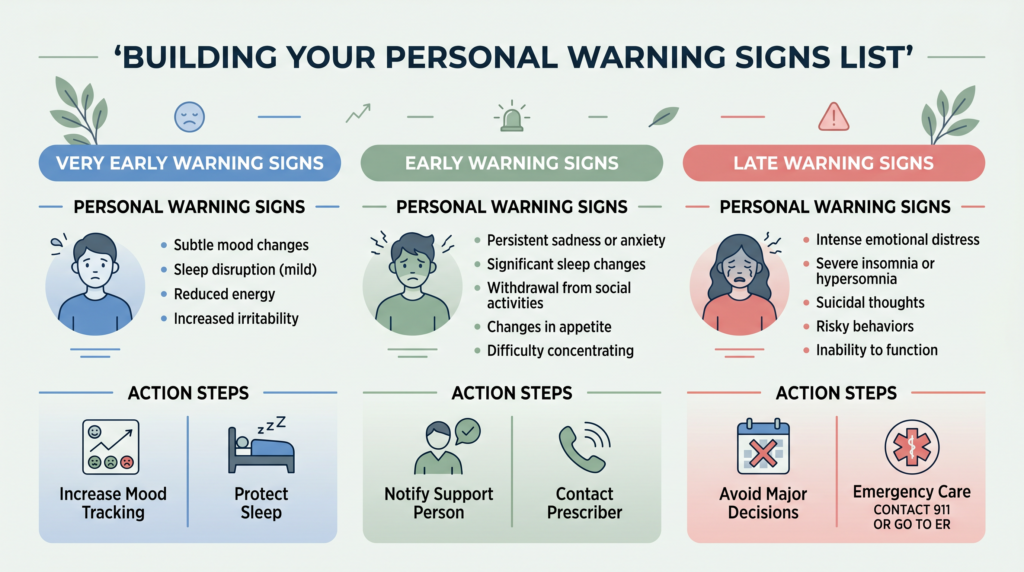
A useful warning signs list should be short, specific, and easy to act on. Organize it into three levels: very early signs, early signs, and late signs.
For each sign, describe what it looks like in real life. Write what another person could actually notice.
For example, “I start three new projects in one weekend” is useful. “I become activated” is not.
Include the name of the person who tends to notice these changes in you. Sometimes your support person sees the pattern before you can.
Store the list in your phone. Share it with your therapist if you have one, your prescriber, and your designated support person.
What to Do at the Early Stage
When you notice an early warning sign, the goal is to reduce momentum. A small shift is easier to manage than a full crisis.
Contact your prescriber and be concrete. You can say, “I am noticing I have slept five hours for two nights and I feel unusually energized, so I wanted to flag it early.”
Protect sleep right away. Keep your bedtime and wake time steady, lower stimulation at night, and if you tend to get elevated, reduce evening light from screens as much as you can.
Reduce stress where possible. Push non-urgent tasks, avoid overload, and lower the number of demands hitting your system at once.
Tell your support person. Increase mood tracking to daily if you are not already doing that.
What to Do at the Late Stage
When late warning signs are showing up, the situation needs faster action. This is not the time to wait for your next scheduled appointment.
Contact your prescriber the same day. Be direct and specific about what is changing.
Do not make major financial decisions. Do not quit your job, end a relationship, empty an account, book a sudden trip, or make other irreversible moves while your brain may be shifting into crisis mode.
Bring in your trusted person and use your crisis plan. If you are unsafe, unable to care for yourself, or moving toward self-harm, go to the nearest emergency room or call 988 if you are in the U.S.
Making Warning Sign Recognition Work Over Time
The best warning sign system is the one you use before things get dramatic. That usually means some form of daily mood tracking.
Mood tracking helps because memory gets slippery in bipolar disorder. What felt random in the moment often becomes a visible pattern when you look back over weeks and months.
An app like eMoods or any consistent tracking method can help you see the order of events. Maybe your sleep drops first, then your spending rises, then your speech speeds up.
Review your data every month if you can. Share the pattern with your prescriber before appointments, not only when things are falling apart.
Let Your Support Network Help You Sooner
The people close to you often catch warning signs before you do. That is not a weakness in you, it is just part of how episodes can affect insight.
It helps to pre-authorize specific feedback. You can say, “If you notice I am sleeping less than five hours and acting like I do not need rest, please tell me directly.”
A simple shared phrase can make this easier. Something like, “I am noticing your early signs,” can cut through shame and awkwardness when time matters.
Pick people who are steady, honest, and calm. You do not need a crowd, just one or two people who can tell the truth without escalating the situation.
Review Your List Every Year
Your warning signs can shift over time. Age, stress, medication changes, seasons, and life stages can all change the order or shape of your early signals.
Review your list at least once a year, and again after any major episode. Ask what you missed, what showed up earlier than expected, and what turned out to be more important than you thought.
Maybe last time the first sign was not sleep. Maybe it was a spike in panic, a spending app pattern, or a sudden flood of late-night ideas.
That is useful information. You are not starting from zero each time if you keep learning your own sequence.
Charting Your Next Baseline
You do not need to predict every episode perfectly. You just need to get better at noticing when your mind starts speaking in its early language.
That language is personal. It may be less sleep, more certainty, more agitation, more withdrawal, more heaviness, or thoughts that turn darker and narrower by the day.
The more clearly you know your own pattern, the earlier you can act. And in bipolar disorder, earlier often means safer.
If you take one thing from this post, let it be this. A bipolar crisis usually whispers before it shouts.
Listen for the whisper. Then get help while your options are still wide open.