


How To Create A Personal Crisis Plan For Bipolar Disorder
When you live with bipolar disorder, fear can make every small shift feel loaded. You need something solid to hold when your own mind stops feeling safe, and a bipolar disorder crisis plan can be that thing.
This plan is not about giving up control. It’s about protecting your future self, the one who may be scared, wired, shut down, or too exhausted to think clearly.
Why A Crisis Plan Matters And When To Build It
A crisis plan is a written guide you make during a steadier stretch. It tells you and the people around you what to do, who to call, and what signs mean it is time to act.
That matters because bipolar episodes can hijack judgment before you fully see what’s happening. The version of you who is stable can often spot patterns and make safer choices long before the version of you in crisis can.
Think of it as your well-self leaving a map for your unwell-self. It also gives your support people a script, which helps when everyone is scared and minutes matter.
This is also bigger than the old idea of a “promise not to hurt yourself.” Research in suicide prevention has shifted toward practical, personalized safety planning because clear action steps tend to help more than vague intentions.
So build this now, not in the middle of an episode. Even if you’re only partly stable, that is still a better starting point than trying to write it while your brain is on fire.
What A Bipolar Disorder Crisis Plan Includes
A good crisis plan is personal. It should sound like your life, your patterns, your risks, and your people.
Start with self-knowledge. Before meds, before therapy changes, before emergency steps, you need to name how your episodes usually begin.
My Personal Warning Signs
Your brain usually whispers before it shouts. If you can catch the whisper, you have a better shot at slowing things down.
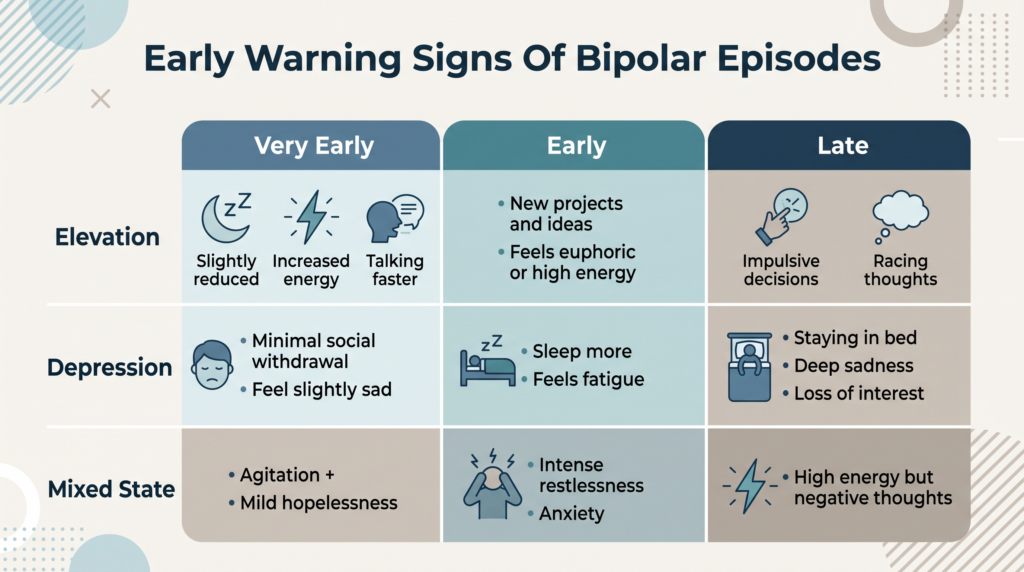
Mania And Hypomania Warning Signs
When your brain’s reward system starts pressing the accelerator too hard, sleep can drop, ideas can multiply, and caution can fade. That early revving can become hypomania or mania, but it often starts with small, repeatable signs.
Write down your signs, not generic ones from a checklist. The more specific you get, the more useful the plan becomes.
You might write things like: “I sleep less than 5 hours and still feel great.” Or, “I start three new projects in the same week and feel sure I can finish all of them.”
You might also notice, “I text people I haven’t talked to in months.” Or, “I start talking faster and interrupting people.”
It helps to sort these by timing. Use three stages: very early, early, and late.
Very early signs may show up weeks before an episode. Early signs may show up days before, and late signs may show up in the final hours when risk starts climbing fast.
Ask your support people what they see that you miss. Sometimes the people who love you notice the edge in your voice, the spending, the grand plans, or the drop in sleep before you do.
Depression Warning Signs
When the brain’s energy, motivation, and stress systems start dragging, life can narrow fast. That slowdown can become bipolar depression, but again, it usually leaves tracks.
Write your own tracks down. Keep them concrete.
You might say, “I stop answering texts.” Or, “I turn down invitations I would normally want.”
You might add, “I stay in bed more than an hour after my alarm.” Or, “I eat more, move less, and start gaining weight quickly.”
Use the same stages here. Very early, early, and late.
That structure matters because a sign that seems small on Tuesday can look very different when it stacks with five others by Friday.
Mixed-State Warning Signs
Mixed states deserve special attention. They can be some of the riskiest bipolar states because they combine distress, speed, agitation, and hopelessness all at once.
You may feel driven but miserable. You may have more energy than usual but also feel despair, rage, panic, or suicidal thoughts.
If mixed states are part of your pattern, put that in bold in your plan. If you think you are entering a mixed state, that is usually a same-day call to your prescriber.
What Helps And What Makes Things Worse
Once you know the signs, the next step is knowing what changes the temperature. Some things bring your nervous system down a notch, and some pour gasoline on it.
What Helps During Elevation
When your brain is running too hot, the goal is to reduce stimulation and protect sleep. Evidence from bipolar care consistently points to regular routines and sleep protection as core stabilizing tools, especially for people whose episodes are triggered by rhythm changes.
Write down specific actions that help you de-escalate. Keep them simple enough to do when your judgment is slipping.
Examples might include: “Take a 30-minute walk without music.” Or, “Go to bed at 10 p.m. no matter how awake I feel.”
You might add, “Call Sam because he stays calm with me.” Or, “Hand over my credit cards when I have slept less than 5 hours for two nights.”
Also list what to avoid during elevation. Common ones are caffeine, alcohol, late-night screens, stimulating social plans, and financial websites.
What Helps During Depression
When your brain is underpowered, the goal is often gentle activation and connection. Research on bipolar depression supports small, structured actions that reduce isolation and keep daily rhythms from collapsing, though severe depression may also need urgent clinical support.
Write down tiny steps that still count. Not ideal steps, just real ones.
Examples might include: “Take a 10-minute walk outside even if I hate the idea.” Or, “Text one person and say, ‘I’m struggling.’”
You might also write, “Eat something, anything, even if I’m not hungry.” Or, “Shower and change clothes before noon.”
Then list what tends to make depression worse. Common examples are complete isolation, alcohol, sleeping all day, and ignoring every call.
What Makes Things Worse
This section can save you a lot of damage. The point is to name your repeat escalators before you’re tempted to argue with them.
You might write things like: “Arguing with my ex.” “Checking social media after 10 p.m.” “Skipping meals.” “Missing meds.” “Working late for three nights in a row.”
Be blunt here. Your crisis plan is not a place for perfect self-image.
My Personal Contacts And Their Roles
In a crisis, vague support is not enough. People need names, numbers, and jobs.
Primary Support Person
Pick one person first. This is the person most likely to answer, stay steady, and follow the plan.
Include their name and phone number. Then write exactly what they are authorized to do.
That might include contacting your prescriber, coming with you to the ER, holding your credit cards, or staying on the phone while you get help. If you want, add the words you want them to use when they notice warning signs.
That part matters more than people think. A calm agreed-on sentence like, “I think your sleep change means we need to call your prescriber now,” is often more useful than debate.
Secondary Support Person
Have a backup. Your first person may be asleep, at work, or emotionally flooded.
List their name, number, and role. Keep it clear.
My Prescribing Psychiatrist Or PMHNP
Include your clinician’s name, office phone, and after-hours system if one exists. Then write one or two key facts you want them to know in a crisis.
For example: “I have a history of mixed states with suicidal thoughts and need urgent assessment.” Or, “My manic episodes often start with reduced sleep and spending.”
My Therapist
List your therapist’s contact information too. Then note when to contact them versus your prescriber.
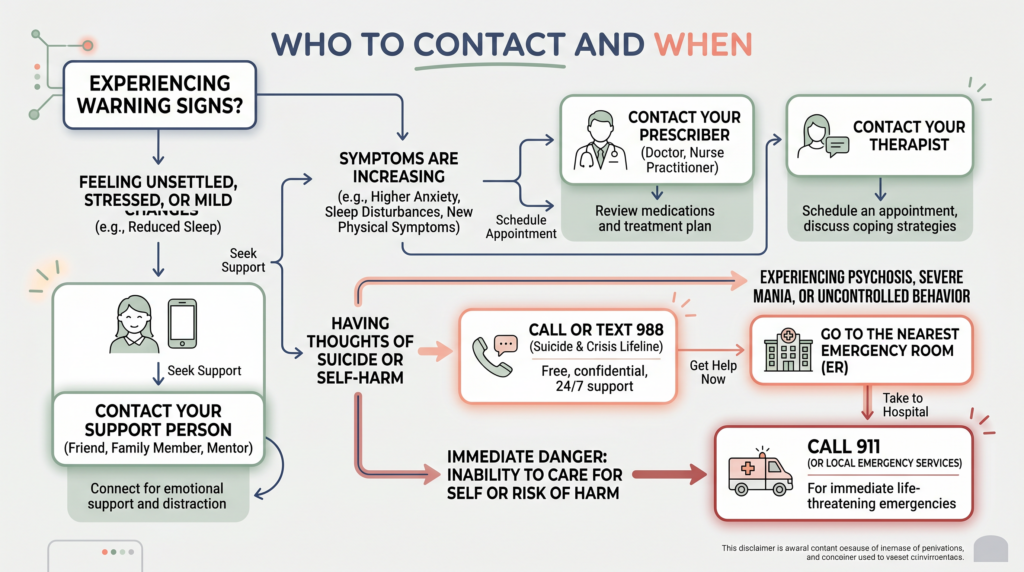
A simple rule helps. If it’s about therapy support and coping, contact your therapist. If it’s a mood shift, med issue, mixed state, or urgent symptom spike, contact your prescriber.
Crisis Resources
Include resources that are always available. Put them in your plan even if you think you’ll remember.
- 988: Call or text for the Suicide and Crisis Lifeline, 24/7
- 741741: Text HOME to reach the Crisis Text Line, 24/7
- Nearest Emergency Room: Write the address and fastest route
- 911 or Local Emergency Services: Use if there is immediate danger
Warning Signs That Mean Contact My Prescriber Today
This part turns “maybe I should mention it later” into a clear line. That line can prevent a bad week from becoming a disaster.
Write the exact signs that mean same-day contact. Make them measurable where possible.
Examples include:
- Sleep has dropped below X hours for Y nights
- I’ve had thoughts of suicide or of not wanting to exist
- I feel like I’m entering a mixed state
- I’ve stopped taking medication
- I’ve made or want to make a financial decision above $X
- I haven’t left the house for more than 3 days
These are not “wait and see” items. They are “call today” items.
Warning Signs That Mean Go To The Emergency Room
This section should be direct. If you are in danger, clarity matters more than comfort.
Write the circumstances that mean go to the ER or call 911. Examples include:
- I have a suicide plan and the means to carry it out
- I have already taken steps to harm myself
- I am hearing, seeing, or believing things that are not real
- I am in a severe manic crisis with dangerous behavior and cannot stop
- I am not eating, not sleeping at all, or cannot care for myself
- My support person believes my safety is at immediate risk
If this section applies right now, stop reading and reach out now. Call or text 988, go to the nearest ER, or call 911 if there is immediate danger.
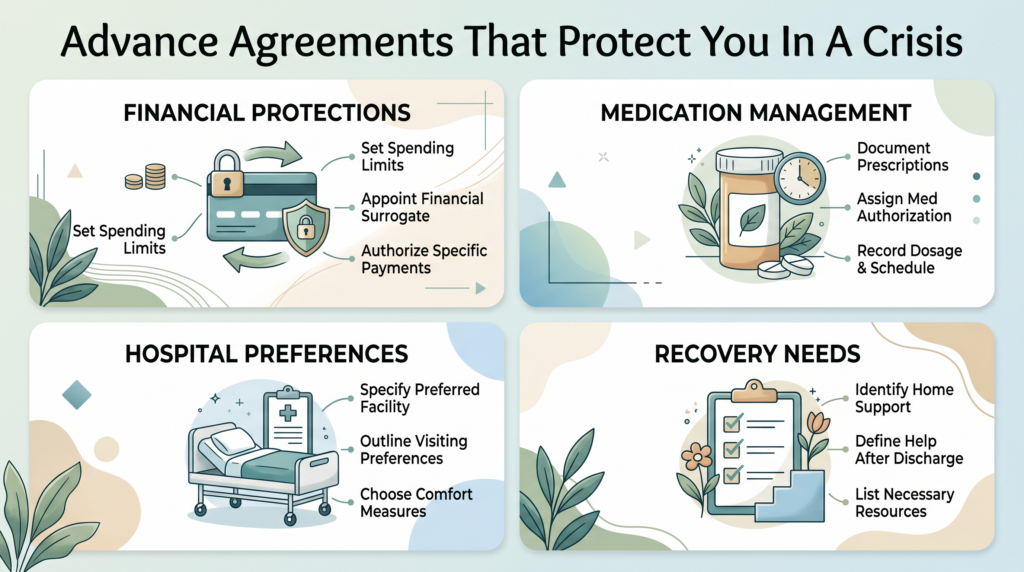
Advance Agreements About My Care
This is where you make decisions while your judgment is intact. Later, those choices can protect your money, your body, and your relationships.
Financial Protections
During mania, the brain can overvalue reward and undervalue risk. Studies and lived experience both show that spending, borrowing, and impulsive financial choices are common in elevated states, especially for people with a history of manic overspending.
Write out the rules now. Examples:
- My support person holds my credit cards when this trigger appears: __
- I will not make financial decisions above $X without talking to: __
- I have frozen my credit at all three bureaus: yes/no
- The PIN or instructions are stored with: __
Keep this part practical. The more exact the trigger, the better.
Medication Management
When an episode builds, remembering meds or agreeing to help can get hard. A simple written permission can help your support person act faster.
You might include:
- I authorize my prescriber to discuss my care with: __
- If I stop taking medication, this person may contact my prescriber: __
- My current medications and doses are: __
One key caveat here is legal privacy rules can vary by setting. Still, written preferences often make crisis communication easier, so ask your prescriber what form they want.
Hospitalization Preferences
This part can later support a psychiatric advance directive if you choose to make one. It gives your care team a clearer picture of what has or has not worked before.
You might include:
- If admitted, I prefer to go to: __
- Medications I’m allergic to or have reacted badly to: __
- Medications that have helped me most: __
- I do / do not authorize ECT if my prescriber recommends it
Keep this factual. In a crisis, short facts travel farther than long stories.
After The Crisis, What Helps Me Recover
A crisis plan should not stop at survival. Recovery has its own needs, and people often get this part wrong.
After an episode, you may feel ashamed, wrung out, foggy, or raw. You may need less advice and more quiet, structure, food, sleep, and time.
Write down what helps. Examples:
- What I need from others after a crisis: __
- It usually takes me this long to feel stable again: __
- Signs I’m recovering are: __
- Please do not say or do these things during recovery: __
This section protects you from the cleanup becoming its own wound.
Format And Storage
A plan only works if people can find it and use it fast. Fancy does not matter here. Accessible matters.
Make It Accessible
Keep one copy on your phone. A locked note or health app can work well.
Keep one printed copy at home in a known spot. Give one to your main support person, and consider giving one to your therapist and prescriber.
Keep It Short Enough To Use
A crisis is not the time for a five-page essay. If it takes too long to scan, it may not get used.
Aim for one page if you can. Two pages is a reasonable max.
Use bullet points and headers. Focus on what to do, who to call, and what to avoid.
Psychiatric Advance Directive Vs. Crisis Plan
A crisis plan is your personal guide. A psychiatric advance directive, often called a PAD, is a legal document in many states.
Your crisis plan can become the raw material for a PAD. The care preferences, hospital wishes, and contact permissions you write now can make that legal document much easier to build later.
Building Your Crisis Plan With Your Treatment Team
You do not have to do this alone. In fact, it often works better if you don’t.
Your Therapist As A Resource
A therapist can help you map patterns you’ve missed. Therapists using CBT or IPSRT often work with routine tracking, trigger awareness, and crisis prep, which makes them especially useful here.
Ask plainly: “Can we work on a personal crisis plan together?” That one sentence can move this from good intention to actual document.
Having The Conversation With Your Support Person
Talk about the plan during a stable period. Do not wait until everyone is frightened.
You can say, “I want to share my crisis plan with you and talk through what I’m asking you to do.” That gives the other person a chance to agree, ask questions, and prepare.
Be clear about what you want them to do. Also be clear about what you do not want.
For example, you might write, “Don’t argue with me about whether I’m having an episode. Just contact my prescriber if these signs show up.” That kind of clarity can save a lot of pain.
Reviewing And Updating Your Crisis Plan
Your patterns may change over time. Your meds may change, your support people may change, and your warning signs may get clearer.
Review the plan at least once a year. Also review it after any episode.
Ask: What did we miss. What helped. What failed. What do I want changed before next time.
Update names and numbers right away when your team changes. If the plan worked, write down what worked so you can trust it more next time.
If the plan failed, that does not mean you failed. It means the document needs better information.
A Simple Crisis Plan Template To Start Today
If a blank page makes your brain freeze, start here. Copy this into your notes app and fill it in.
My Bipolar Disorder Crisis Plan
My Name:
Date Updated:
### My Very Early Warning Signs
–
### My Early Warning Signs
–
### My Late Warning Signs
–
### Signs Of Elevation
–
### Signs Of Depression
–
### Signs Of A Mixed State
–
### What Helps Me During Elevation
–
### What Helps Me During Depression
–
### What Makes Things Worse
–
### Contact My Prescriber Today If
–
### Go To The ER Or Call 911 If
–
Primary Support Person
Name:
Phone:
What They Can Do:
Secondary Support Person
Name:
Phone:
Role:
Prescriber
Name:
Phone:
After-Hours Contact:
Therapist
Name:
Phone:
Crisis Resources
988
741741
Nearest ER:
### Financial Protections
–
### Medication List
–
### Hospital Preferences
–
### After A Crisis, What Helps Me Recover
–
Charting Your Next Baseline
You are not weak for needing a plan. You are wise for making one before the storm starts talking over you.
A bipolar disorder crisis plan is one of the clearest ways to protect your future self with the judgment you have today. Write it while you can think, share it with people you trust, and let it become one more way you stay in the fight.