

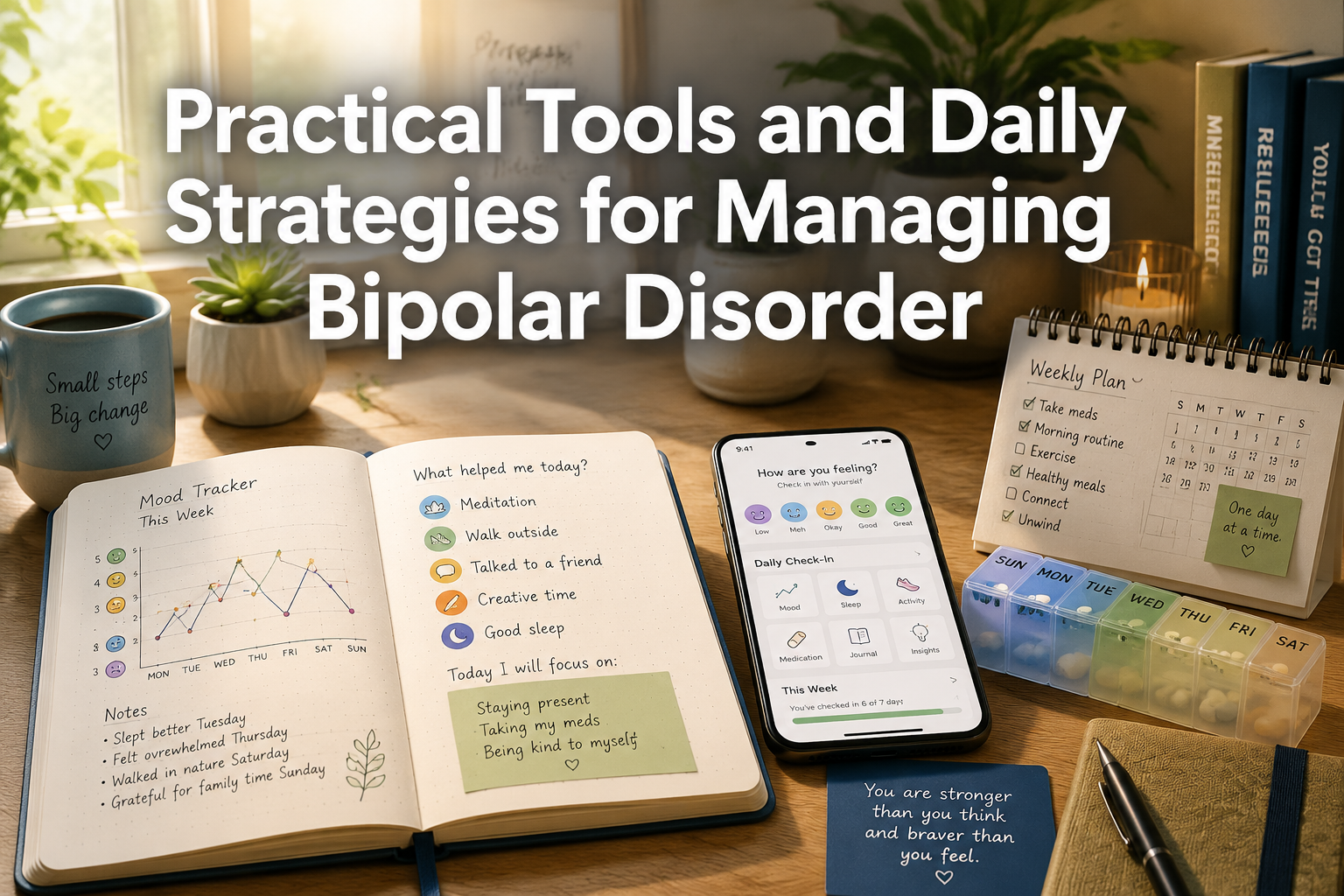
Practical Tools and Daily Strategies for Managing Bipolar Disorder
You didn’t fail because you lack willpower. You’re not struggling because you’re broken or weak or doing this wrong.
The truth is simpler and harder: bipolar disorder is a neurological condition that disrupts the brain’s ability to regulate mood, energy, and sleep, and managing it requires specific bipolar disorder management tools that match how your nervous system actually works.
You need structure that bends without breaking, tracking systems that reveal your earliest warning signs, and crisis plans built before the storm hits.
This isn’t about perfection. It’s about building a management protocol that keeps you stable enough to live the life you want, using plain English strategies backed by decades of clinical data.
Key Takeaways
- Mood tracking reveals your polarity pattern and helps you spot your earliest warning signs before episodes fully develop
- Appointment preparation tools transform doctor visits from rushed check-ins into strategic treatment planning sessions
- Crisis preparedness plans created during stable periods become your safety net when your brain can’t think clearly
- Anchor-point routines protect your sleep architecture and nervous system regulation without requiring rigid perfection
- Cycle awareness before treatment selection ensures you match the intervention to your episode type and personal baseline
Why Tools and Structure Matter in Bipolar Management
Your brain’s mood regulation system doesn’t work the way it does in people without bipolar disorder. When your limbic system gets stuck holding down the accelerator during mania or cuts power entirely during depression, you can’t simply think or willpower your way back to baseline. You need external scaffolding.
Bipolar disorder management tools serve as that scaffolding. They create predictability when your internal state feels chaotic, capture data your brain will forget during episodes, and automate decisions you can’t make clearly when symptomatic. The right tools don’t add burden—they reduce the cognitive load of managing a complex condition.
Structure matters because bipolar disorder thrives in chaos. Irregular sleep, unpredictable routines, and untracked symptoms create the perfect conditions for mood destabilization. But structure doesn’t mean rigidity. It means building flexible systems that adapt to your energy levels while maintaining the core elements that keep your nervous system regulated.
Mood Tracking: The Most Fundamental Tool
Mood tracking is the foundation of sustainable stability. Without it, you’re flying blind, unable to distinguish your true baseline from early episode symptoms or medication side effects from natural mood variation.

Why Mood Tracking Works
Tracking works because it externalizes pattern recognition. Your brain during an episode can’t reliably assess whether you’re “fine” or sliding into hypomania—the very nature of mood episodes distorts self-perception. But data doesn’t lie.
When you track consistently for three to six months, your polarity pattern emerges. You’ll see that your depressions always start with sleep disruption and social withdrawal, or that your hypomanic episodes creep up in spring with increased goal-directed activity and racing thoughts. This knowledge becomes your early warning system.
The mechanism is simple: you’re creating a mood tracking inventory that your treatment team can use to adjust medications before full episodes develop. Research shows that people who track mood consistently have fewer hospitalizations and better medication adherence, not because tracking itself stabilizes mood, but because it enables faster, more precise interventions.
What to Track Daily
Your daily tracking should capture five core elements. First, sleep: hours slept, sleep quality, time to bed, time awake. Sleep disruption is often your earliest warning sign for both poles. Second, mood: rate it on a simple scale (negative five to positive five works well, with zero as your baseline).
Third, energy and activity level: are you accomplishing normal tasks, or are you either sluggish or revved up? Fourth, medications taken: this catches adherence gaps before they cause problems. Fifth, significant triggers or stressors: did something happen that might explain mood shifts?
You don’t need to write essays. Three minutes of data entry beats elaborate journaling you’ll abandon in two weeks. Consistency matters more than detail.
Track warning signs specific to your pattern. If irritability always precedes your manic episodes, track it daily. If anhedonia signals depression, rate your interest in normally enjoyable activities. Customize your tracking to match your personal bipolar signature.
Digital Tracking Tools
Digital apps offer convenience and automatic graphing. eMoods, Daylio, and Bearable are popular options designed specifically for mood tracking. They let you log multiple variables quickly, set reminders, and generate charts you can share with your psychiatrist.
The advantage of digital tools is pattern visualization. Seeing your mood graphed over months makes connections obvious that daily entries obscure. You’ll notice that your mood dips every time you skip exercise for three days, or that certain medications correlate with specific side effects.
Choose apps that export data. You want to own your information and be able to print reports for appointments with your healthcare team. Cloud backup prevents data loss if you switch phones.
Paper Tracking Tools
Paper works better for some people. There’s no app to open, no phone to charge, no digital friction. A simple notebook or printed tracking sheet by your bedside removes barriers.
Create a one-page monthly tracker with rows for each day and columns for your core variables. Use colored pens or highlighters to make patterns visually obvious. Some people prefer bullet journal-style tracking with custom symbols and layouts.
The side-effect trade-off with paper is manual graphing and no automatic reminders. But if paper means you’ll actually do it, that trade-off is worth it. Consistency beats sophistication every time.
How to Use Your Tracking Data
Data without analysis is just numbers. Every two weeks, review your tracking. Look for patterns: mood shifts that correlate with sleep changes, energy dips after certain activities, medication timing that affects side effects.
Bring your tracking to every psychiatrist appointment. It transforms vague reports (“I’ve been okay, I guess”) into specific, actionable information (“My mood dropped from plus-two to minus-three over five days, starting right after I reduced my sleep by two hours three nights in a row”). Your doctor can adjust treatment based on objective data rather than your potentially distorted recall.
Use tracking to test hypotheses. If you suspect caffeine after 2pm disrupts your sleep, track it for a month. If you think morning exercise stabilizes your mood, track that relationship. You’re building a personalized map of what helps and what hurts.
The Appointment Preparation Toolkit
Psychiatrist appointments are typically fifteen to thirty minutes. You can’t afford to waste that time trying to remember what happened since your last visit or forgetting to ask critical questions. Preparation tools maximize every minute.
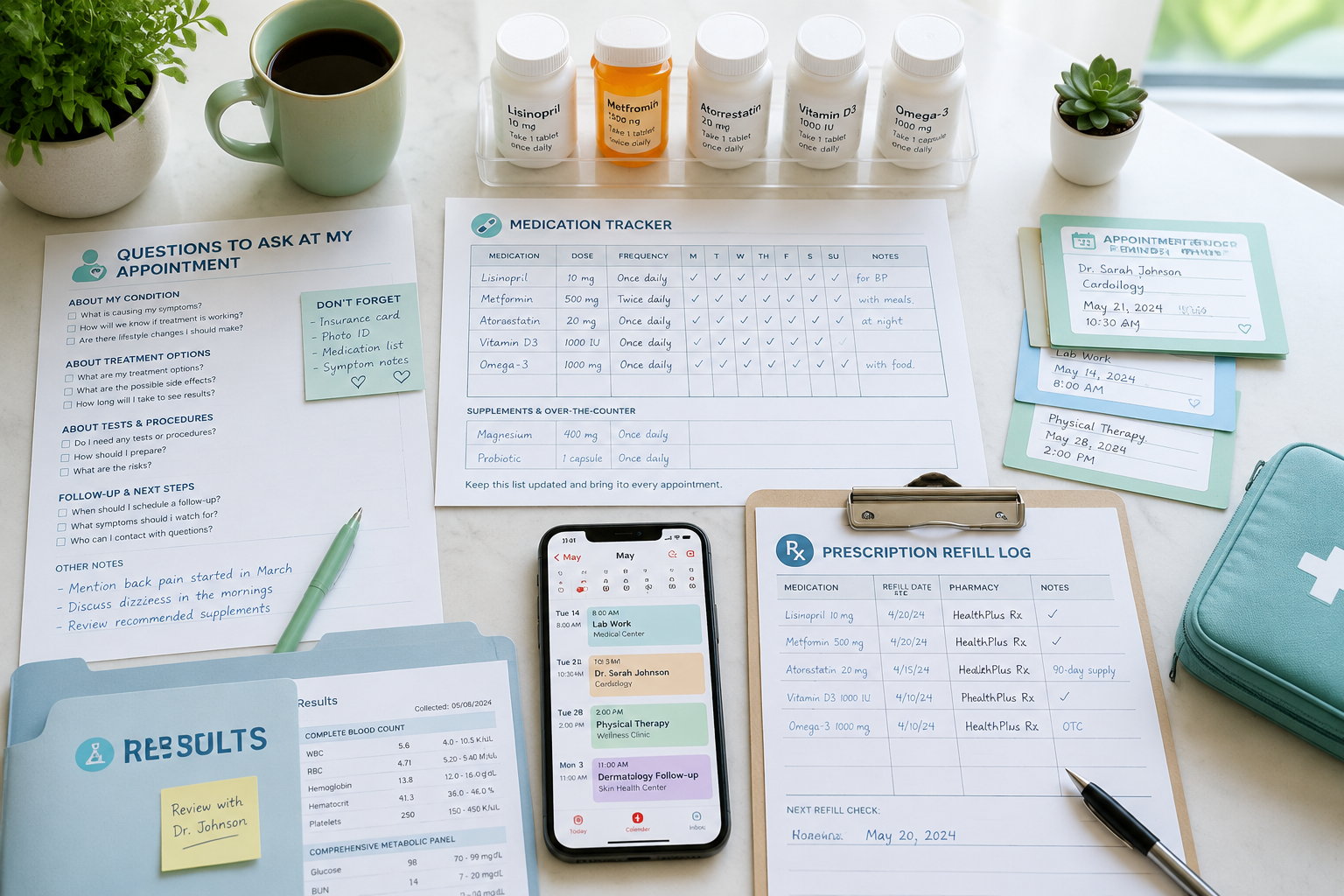
Questions to Ask Your Doctor (Preparation List)
Before each appointment, write down your questions. Keep a running list between visits so you don’t forget concerns that arise at 2am. Prioritize your top three questions—if time runs short, you’ll cover what matters most.
Essential questions include: “Based on my tracking, do you see any concerning patterns?” “Are my current symptoms likely medication side effects or breakthrough symptoms?” “What’s our plan if this medication doesn’t work?” “What warning signs should prompt me to call before my next scheduled appointment?”
Ask about the mechanism behind treatment changes. “How does increasing this dose address my specific symptoms?” Understanding the why helps you evaluate whether the intervention is working and builds your knowledge base for future decisions. This is cycle awareness before treatment selection in action.
Don’t leave without clarity on next steps. “So I’m increasing to 150mg for four weeks, then we’ll reassess based on my mood tracking—is that right?” Confirm the plan out loud.
Medication Tracking Chart
Create a simple chart listing every medication, supplement, and over-the-counter drug you take. Include the dose, frequency, prescribing doctor, start date, and reason prescribed. Update it whenever anything changes.
This chart prevents dangerous interactions and ensures every provider knows your complete medication list. It’s especially critical if you see multiple specialists or end up in an emergency room during a crisis.
Track side effects alongside medications. Note when side effects started, their severity, and whether they improved over time. This helps distinguish temporary adjustment effects from persistent problems requiring intervention. Many side effects diminish after two to four weeks—knowing this prevents premature medication abandonment.
Include a section for medications you’ve tried and stopped, with dates and reasons. This prevents your doctor from suggesting something that already failed or caused intolerable side effects. It’s your personal “what doesn’t work for me” reference.
Health Care Appointments Calendar
Maintain a dedicated calendar for all health-related appointments: psychiatry, therapy, primary care, lab work, dental, everything. Set reminders forty-eight hours before each appointment and again the morning of.
Color-code by appointment type. This visual system helps you see at a glance whether you’re maintaining appropriate follow-up frequency. If you notice you haven’t seen your psychiatrist in four months when you’re supposed to go every six weeks, that gap becomes obvious.
Include travel time in your calendar entries. Rushing to appointments increases stress and reduces your ability to engage effectively. Build in buffer time.
Prescription Refill and Lab Testing Log
Track when you last refilled each medication and when you’re due for refills. Set reminders five days before you’ll run out—this prevents the dangerous gap that happens when you realize on Friday evening that you’re taking your last dose and the pharmacy is closed until Monday.
Many bipolar disorder medications require regular lab monitoring. Lithium needs blood level checks, kidney function tests, and thyroid monitoring. Valproate requires liver function tests. Create a log showing which tests you need, how often, when you last had them, and when the next one is due.
Bring this log to appointments. Your doctor may not remember that your last lithium level was six months ago, but your log will. Proactive monitoring prevents complications and keeps treatment safe.
The Crisis Preparedness Toolkit
You build crisis plans when you’re stable because you can’t build them when you’re in crisis. Your brain during a severe episode can’t think clearly, make good decisions, or remember important information. That’s exactly when you need a plan most.
The Written Crisis Plan
Your crisis plan is a document you create during baseline that tells you and others what to do when you’re symptomatic. It should include your earliest warning signs for both mania and depression, specific actions to take when you notice those signs, and clear criteria for when you need emergency help.
List your warning signs by episode type. For depression, yours might include: sleeping more than ten hours, canceling social plans, loss of interest in hobbies, and intrusive thoughts about death. For mania: sleeping less than five hours without fatigue, starting multiple new projects, increased spending, and rapid speech.
Include a trigger-and-response section. “If I notice three or more depression warning signs for two consecutive days, I will: call my psychiatrist’s office for an urgent appointment, increase therapy frequency, ask my partner to take over complex decisions, and eliminate alcohol completely.”
Specify your crisis contacts: psychiatrist’s office number, after-hours crisis line, trusted friend or family member who understands your condition, and local emergency services. Make this information immediately accessible—tape it inside your medicine cabinet, save it in your phone, give copies to your support people.
Write down what helps during episodes. During depression: gentle walks, simplified meal prep, reduced decision-making, increased social contact even when you don’t want it. During hypomania: strict sleep schedule, reduced stimulation, someone else managing finances, avoiding major decisions. You won’t remember these strategies when you need them, but your plan will.
Include what doesn’t help or makes things worse. “Don’t isolate completely” or “Don’t make big purchases without a forty-eight-hour waiting period” or “Don’t stop medications even if I feel great.” Your symptomatic brain will try to do exactly these things—your plan is there to stop you.
The Medication Safety Net
Keep an emergency medication supply. If you take daily medications, maintain at least a one-week backup supply in a labeled container separate from your daily pills. This protects against pharmacy delays, lost prescriptions, or travel disruptions.
Store your backup supply somewhere you’ll remember but won’t accidentally take it. A labeled bag in your sock drawer works better than a random bottle in a junk drawer. Check expiration dates every six months.
Create a medication information card for your wallet listing all current medications, doses, allergies, your diagnosis, and your psychiatrist’s contact information. In an emergency, this ensures medical personnel have critical information even if you can’t communicate clearly. You can find templates online or create a simple version in a word processor.
Consider a medication management system if you struggle with adherence. Weekly pill organizers with morning/evening compartments remove the “did I take it?” uncertainty. Smart pill bottles or apps that track when you open your medication container add another layer of accountability. The goal is to make taking medications the path of least resistance.
Building Routines That Stick
Routines protect your sleep architecture and regulate your nervous system, but only if they’re sustainable. Elaborate morning rituals that require ninety minutes of perfect execution will fail. You need routines that work even when you’re symptomatic.
Start With Anchor Points, Not a Full Schedule
Anchor points are non-negotiable activities that happen at the same time every day. They create rhythm without rigidity. Your two most important anchors are wake time and bedtime.
Pick a wake time you can maintain seven days a week, including weekends. Consistency matters more than the specific hour. If you wake at 7am weekdays but sleep until noon on Saturdays, you’re essentially giving yourself jet lag twice a week. That disruption destabilizes mood.
Your bedtime anchor is equally critical. Decide on a time when you’ll begin your wind-down routine, not when you’ll be asleep. This accounts for the fact that falling asleep takes time. If you want to be asleep by 11pm, your wind-down might start at 10pm.
Add one or two more anchors: a consistent meal time, an exercise window, or a medication time. Don’t add more until these core anchors are automatic. You’re building habits, and habits form through repetition, not through creating elaborate systems you’ll abandon.
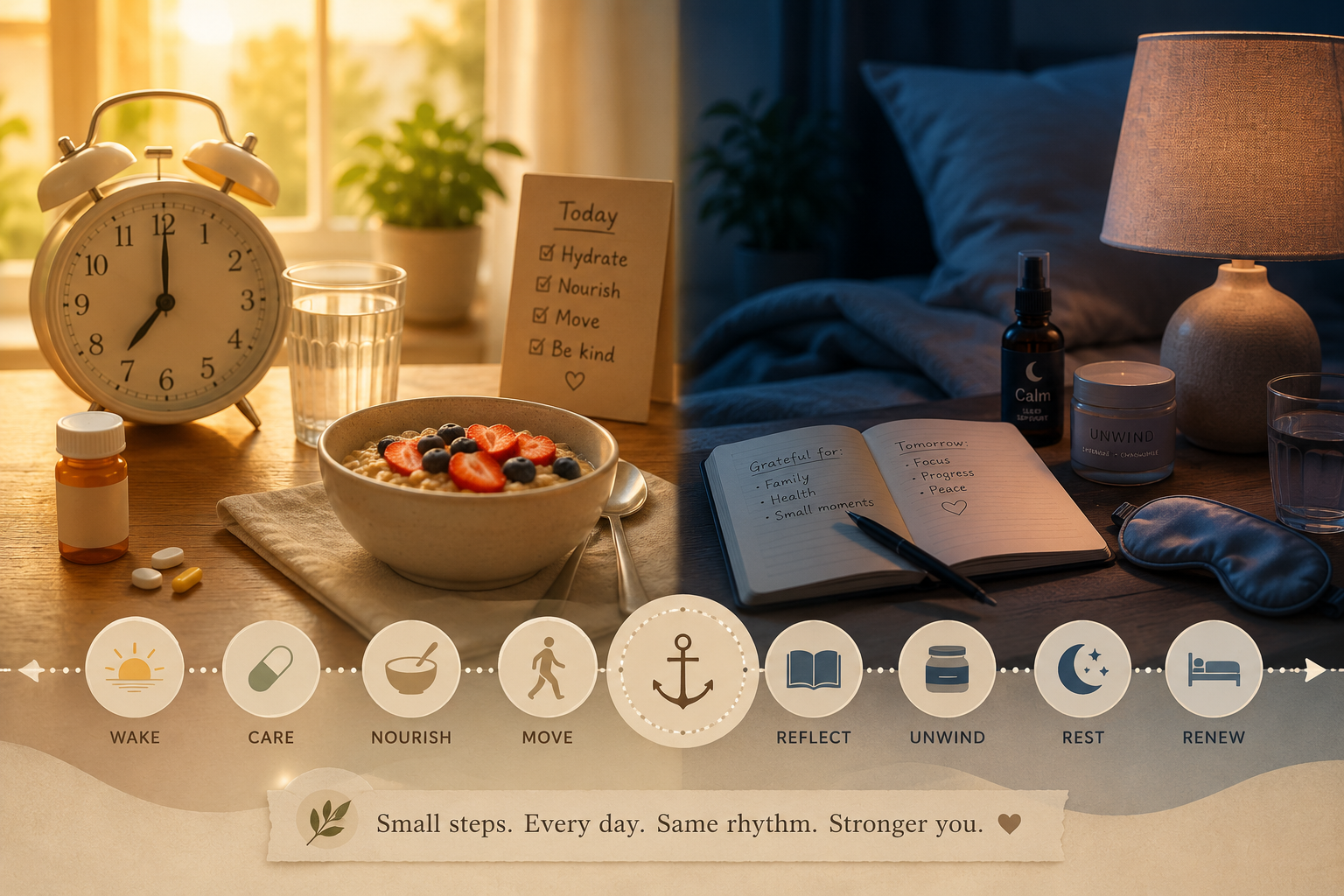
Making Habits Stick
Habit formation requires reducing friction and increasing consistency. Make your desired behaviors easier to do than not do. If you want to take morning medications consistently, keep them next to your coffee maker with a glass already there. When you go for coffee, you’ll see the pills.
Stack new habits onto existing ones. “After I brush my teeth, I’ll do my mood tracking” works better than “I’ll track my mood sometime in the morning.” The existing habit (teeth brushing) becomes the trigger for the new one.
Start smaller than feels necessary. If you want to exercise regularly, start with five minutes. The goal is consistency, not intensity. You can increase duration once the habit is established, but you can’t build on a habit that never forms because the barrier was too high.
Track your habit completion. A simple checkmark on a calendar creates a visual chain you won’t want to break. This isn’t about perfection—missing a day doesn’t mean failure. It means you get back on track the next day.
Managing Disruption
Life disrupts routines. Travel, illness, schedule changes, and episodes themselves will knock you off track. The goal isn’t to prevent disruption—it’s to minimize damage and return to baseline quickly.
When you know disruption is coming (travel, schedule change), plan your adaptation in advance. If you’re traveling across time zones, gradually shift your sleep schedule before you leave. If you’re starting a new job with different hours, adjust your anchors two weeks before you start.
During disruption, protect your most critical anchor: sleep. Everything else can flex, but sleep consistency is non-negotiable. If you can’t maintain your full routine, maintain your wake time and bedtime. That alone will prevent significant destabilization.
After disruption, return to your anchors immediately. Don’t wait for Monday or the first of the month. The day after disruption ends, resume your routine. The longer you wait, the harder it becomes to restart.
Charting Your Next Baseline
You now have the core bipolar disorder management tools that create sustainable stability: mood tracking that reveals your patterns, appointment preparation that maximizes treatment effectiveness, crisis plans that protect you during episodes, and routines that regulate your nervous system without demanding perfection.
Start with one tool. If you’re not tracking mood, start there—it’s the foundation everything else builds on. If you’re already tracking but don’t have a crisis plan, create that next. If you have both but your routines are chaotic, focus on establishing two anchor points.
These tools work because they match how bipolar disorder actually operates. They don’t require you to be someone you’re not or to achieve perfect stability before they’re useful. They work during episodes, during baseline, and during the messy in-between periods that make up most of life with this condition.
Your management protocol will evolve. What works during a stable period might need adjustment during a stressful life phase. The tools themselves stay the same, but how you use them adapts to your current needs. That flexibility is the point—you’re building a system that bends without breaking, just like you’re learning to do.
The path forward isn’t about curing bipolar disorder or achieving some mythical perfect stability. It’s about building the infrastructure that lets you live your life while managing a complex neurological condition. These tools are that infrastructure. Start building today.
Frequently Asked Questions
How long does it take for mood tracking to show useful patterns? Most people see meaningful patterns after six to eight weeks of consistent daily tracking. You need enough data points to distinguish true patterns from random variation. Three months of tracking typically provides enough information to identify your earliest warning signs and common triggers.
What if I forget to track my mood for several days? Don’t try to backfill from memory—your recall will be unreliable. Just resume tracking from today forward. Consistency matters more than perfection. If you frequently forget, set a daily phone reminder or pair tracking with an existing habit like morning coffee.
Should I share my crisis plan with family members even if they don’t fully understand bipolar disorder? Yes. Give copies to anyone who might be present during an episode. Include a brief explanation of what behaviors they might observe and what specific help you need. You don’t need them to understand the neuroscience—you need them to follow the plan when you can’t think clearly.
How do I know if my routine is too rigid versus appropriately structured? Your routine is too rigid if missing one element derails your entire day or causes significant anxiety. Appropriate structure means you have anchor points that guide your day, but you can flex around them when needed. If you can’t adapt to unexpected changes without destabilizing, simplify your routine to fewer, more essential anchors.
What’s the most important tool to start with if I’m newly diagnosed? Start with mood tracking and establishing consistent sleep times. These two tools provide the foundation for everything else. Tracking shows you what’s happening, and sleep consistency prevents the disruption that triggers episodes. Add other tools once these two are habits.
How often should I update my crisis plan? Review and update your crisis plan every six months or after any major episode. Your warning signs may evolve, your support network might change, or you might discover new coping strategies that work. Keep the document current so it’s useful when you need it.